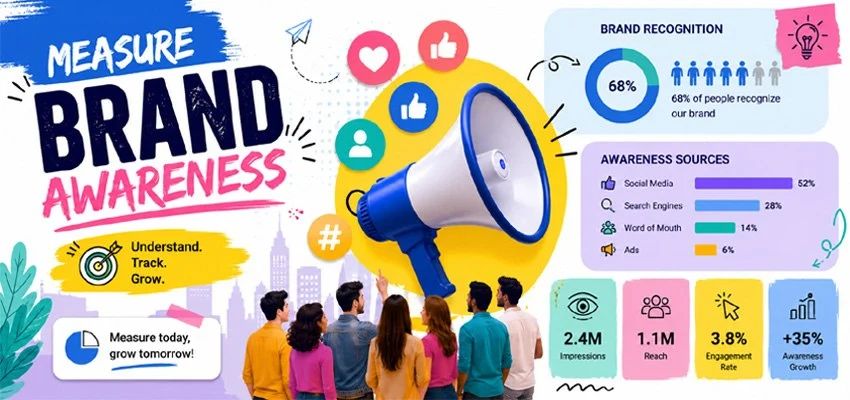
Brand awareness is one of the most valuable — and most elusive — assets a business can build. Everyone agrees it matters. Far fewer people agree on how to measure it. Unlike revenue or conversion rates, brand awareness doesn’t live in a single dashboard. It’s scattered across surveys, social platforms, search engines, and the minds of your potential customers.
This guide cuts through the confusion. Here’s exactly how to measure brand awareness in a way that gives you actionable, reliable data — not just vanity metrics.
What Does “Brand Awareness” Actually Mean?
Before measuring anything, it helps to be precise about what you’re measuring. Brand awareness exists on a spectrum:
Unaided awareness (also called “top-of-mind awareness”) is when someone thinks of your brand without being prompted. If you ask someone, “What’s the first coffee brand that comes to mind?” and they say your name — that’s unaided awareness.
Aided awareness is when someone recognises your brand after being shown it. “Have you heard of Brand X?” They may not have thought of you spontaneously, but they know who you are.
Brand recall sits between these — it’s the ability to retrieve your brand from memory when given a product category cue. Each of these layers requires slightly different measurement approaches.
1. Brand Awareness Surveys
Surveys remain the gold standard for measuring brand awareness, particularly unaided and aided recall. They go straight to the source: your target audience’s memory.
How to run one effectively:
For unaided awareness, ask open-ended questions such as: “When you think of [product category], which brands come to mind?” Record every brand mentioned and track yours over time.
For aided awareness, list several brands — including yours and competitors — and ask: “Which of the following brands have you heard of?”
The key is consistency. Run the same survey, with the same wording, to a comparable audience sample, at regular intervals (quarterly works well for most brands). Month-over-month snapshots are less useful than long-term trend lines.
Tools like Google Forms, Typeform, or dedicated market research platforms (SurveyMonkey Audience, Pollfish) let you reach your target demographic directly. If budget allows, commissioning a research agency gives you cleaner methodology and more defensible data.
2. Direct Website Traffic
One underused proxy for brand awareness is direct traffic — visitors who type your URL into their browser or click a saved bookmark. These are people who already know you exist and seek you out by name.
In Google Analytics 4 (GA4), navigate to Reports → Acquisition → Traffic acquisition and filter for the “Direct” channel. A consistent upward trend in direct traffic, especially among new users, strongly suggests growing brand awareness.
Be aware of a caveat: dark social (links shared in private messages, emails, and encrypted apps) often gets misattributed as direct traffic. This actually means direct traffic may undercount awareness-driven visits, making it an even more reliable signal when the numbers are good.
3. Branded Search Volume
When someone searches for your brand name on Google, they already know you exist. That’s brand awareness in action. Tracking the volume of branded searches over time is one of the clearest quantitative measures available.
Use Google Search Console to see how many impressions and clicks your brand name generates each month. For a broader view, Google Trends lets you compare your brand’s search interest against competitors over time and across regions — completely free.
A rising branded search volume following a campaign, a PR push, or a product launch is one of the most direct ways to prove that your awareness activities are working.
4. Social Media Metrics
Social platforms generate a constant stream of brand awareness signals — if you know where to look.
Mentions and hashtag tracking reveal how often people are talking about your brand unprompted. Tools like Brandwatch, Mention, Sprout Social, and even native platform analytics (Meta Business Suite, X Analytics) let you monitor this over time.
Reach and impressions measure how many unique people see your content. Unlike engagement metrics, reach is a pure awareness number — it doesn’t require any action from the viewer.
Share of voice (SOV) is a particularly powerful metric. It compares your brand’s total mentions or ad impressions to the combined total across your entire competitive category. If your brand accounts for 18% of all online conversations in your industry, that’s your share of voice. Growing SOV typically precedes growing market share.
5. Share of Voice Across Media
Share of voice extends beyond social media. You can measure it across:
- Paid media: Your ad impressions vs. total category impressions (available through ad platforms)
- Earned media: Your press mentions vs. competitor mentions (tracked through media monitoring tools like Meltwater or Cision)
- Organic search: Your rankings and traffic for non-branded category keywords vs. competitors
A comprehensive SOV picture — combining paid, earned, and owned channels — gives you a sophisticated view of how much mental real estate your brand occupies relative to the competition.
6. Net Promoter Score (NPS) and Brand Sentiment
NPS asks one question: “How likely are you to recommend [Brand] to a friend or colleague?” Respondents score 0–10, and you calculate the percentage of Promoters (9–10) minus Detractors (0–6).
While NPS is often categorised as a loyalty metric, it’s deeply tied to brand awareness. People only recommend brands they’re aware of and feel positively about. Tracking NPS alongside awareness surveys reveals whether your growing visibility is translating into positive associations.
Sentiment analysis — categorising brand mentions as positive, neutral, or negative — adds emotional depth to your awareness data. You might be widely known (high awareness) but poorly regarded (negative sentiment). That’s a very different strategic problem than low awareness with positive sentiment among a small audience.
7. Earned Media and PR Coverage
Every article, podcast interview, or review that mentions your brand without paid placement is earned media — and it’s a direct measurement of brand awareness in the public sphere.
Track the following:
- Volume of mentions (how many articles, posts, or broadcasts referenced your brand)
- Reach (combined audience of those outlets)
- Domain authority of coverage sources (a mention in a major publication carries more weight than a small blog)
- Message alignment (are journalists and creators describing your brand the way you want?)
Google Alerts is a free starting point for tracking mentions. For deeper analysis, media intelligence platforms like Meltwater, Cision, or Prowly give you historical data, reach estimates, and sentiment scoring.
8. Customer Surveys and Focus Groups
Quantitative metrics tell you how much — qualitative research tells you what kind. Focus groups and in-depth interviews reveal what associations people have with your brand: what words, images, feelings, and values they connect to your name.
This type of research is especially useful when:
- You’re repositioning your brand and want to understand starting perceptions
- Awareness metrics are high but conversion rates are low (suggesting a perception problem, not a visibility problem)
- You’re entering a new market segment or geography
Building a Brand Awareness Dashboard
Rather than tracking these metrics in isolation, create a simple dashboard that combines:
- Monthly branded search volume (Google Search Console)
- Direct website traffic (GA4)
- Social mentions and share of voice (social listening tool)
- Quarterly survey results (aided and unaided awareness %)
- Earned media reach (PR/media monitoring tool)
Review this dashboard quarterly and look for trends, not just snapshots. Brand awareness builds slowly and erodes slowly — sudden swings usually signal a data anomaly rather than a real-world shift.
The Bottom Line
Measuring brand awareness is never perfectly clean, but that’s no reason to avoid it. The brands that grow consistently are the ones that treat awareness as a measurable, manageable business objective — not a vague aspiration.
Start with two or three of these methods, establish baselines, and track them consistently over time. The story your data tells will get richer with every quarter — and your marketing decisions will get sharper with every data point you collect.